Resurrecting Coherence: An Open-Source Pipeline for Zero-Noise Extrapolation and Dynamical Decoupling on 80-Qubit GHZ States
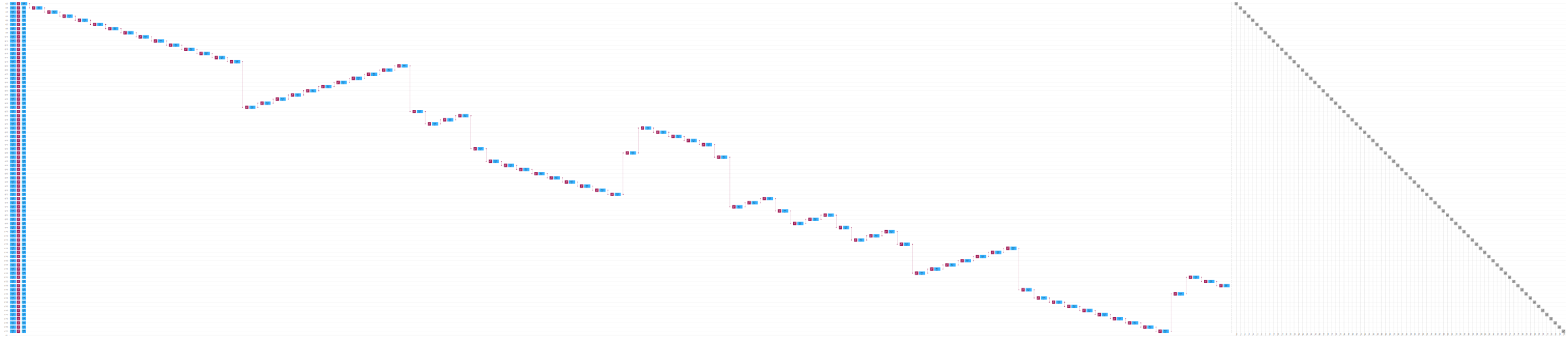 Logical & transpiledCircuits
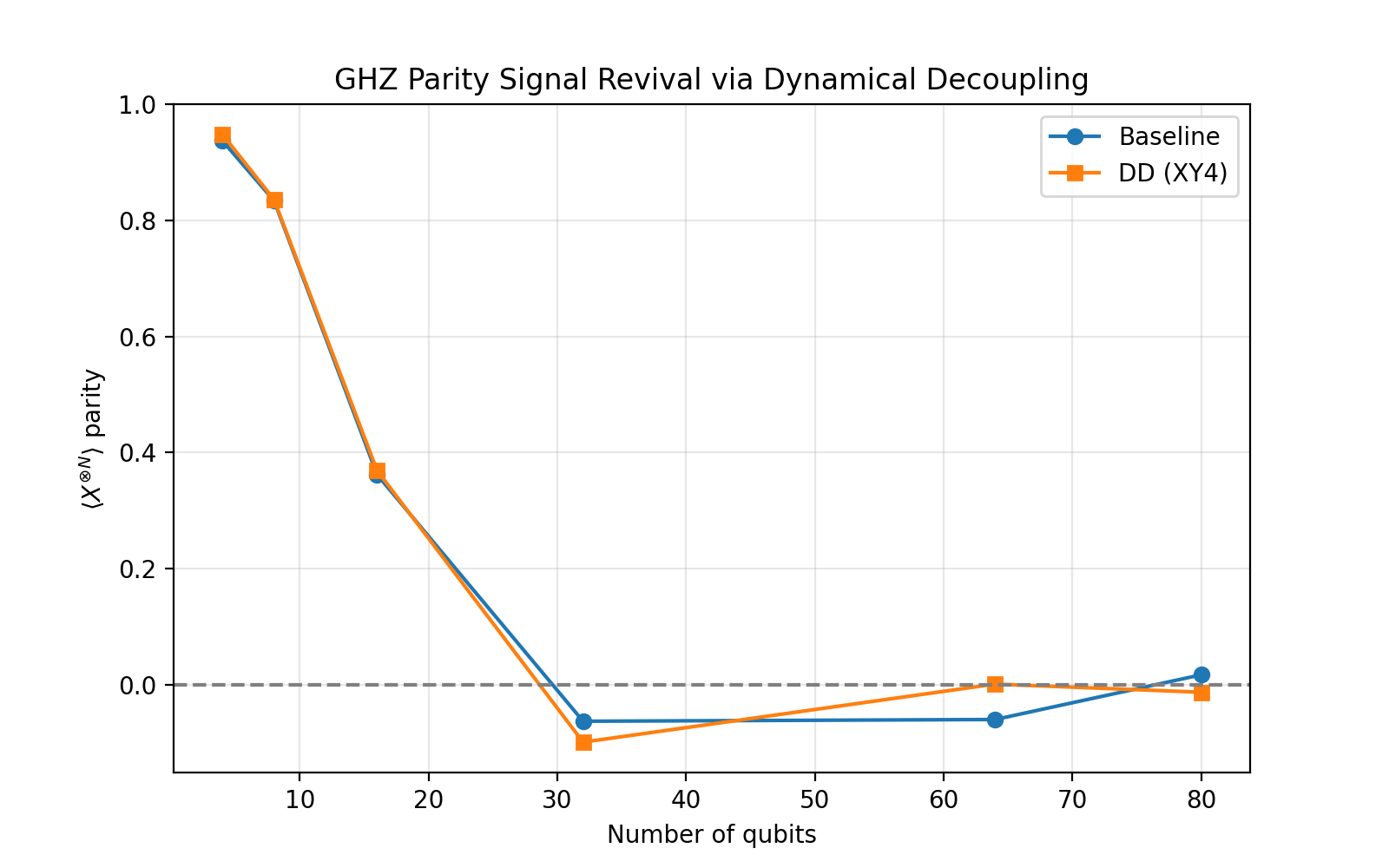 Collapse signalParity
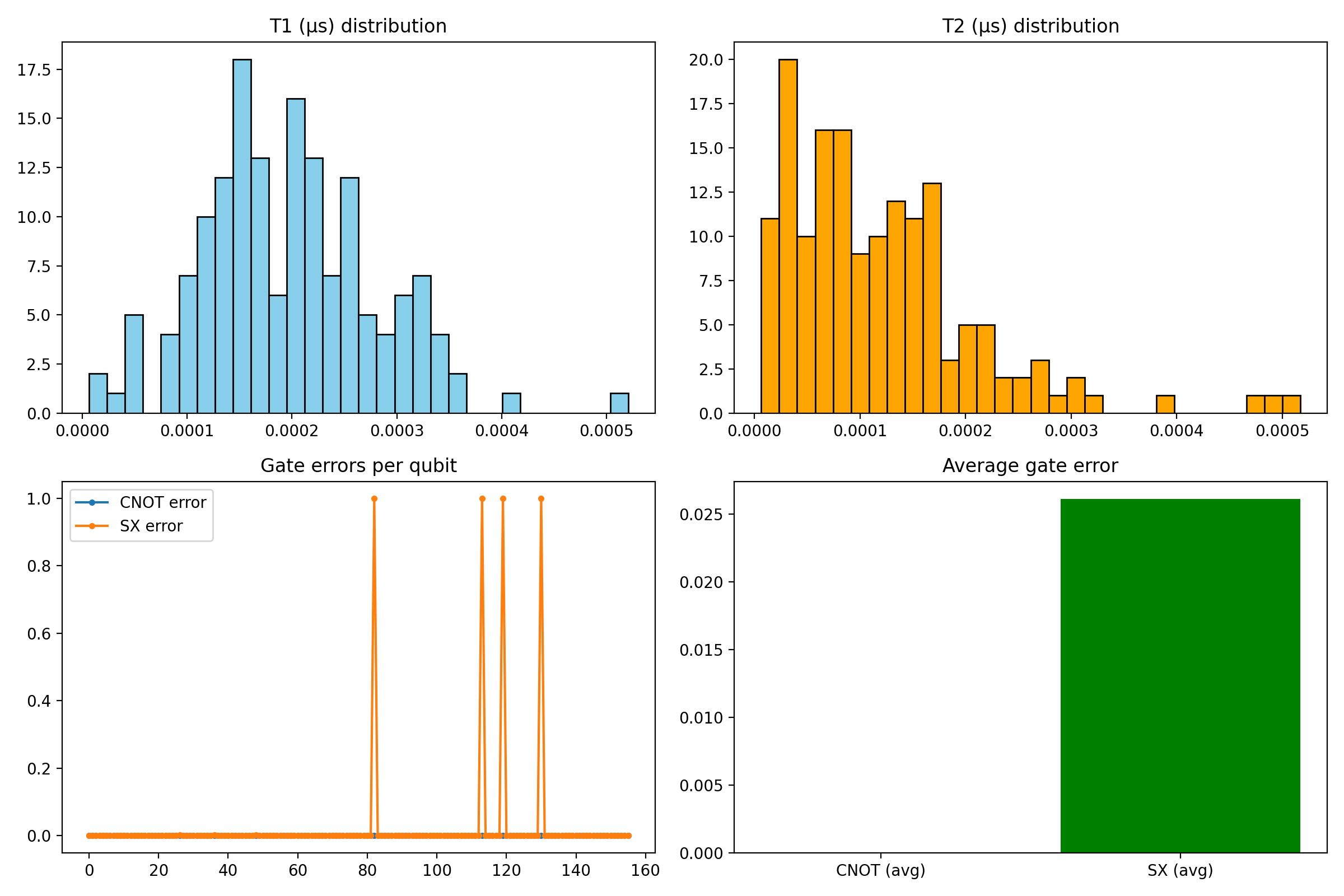 Backend noiseCalibrationExtrapolationZNE
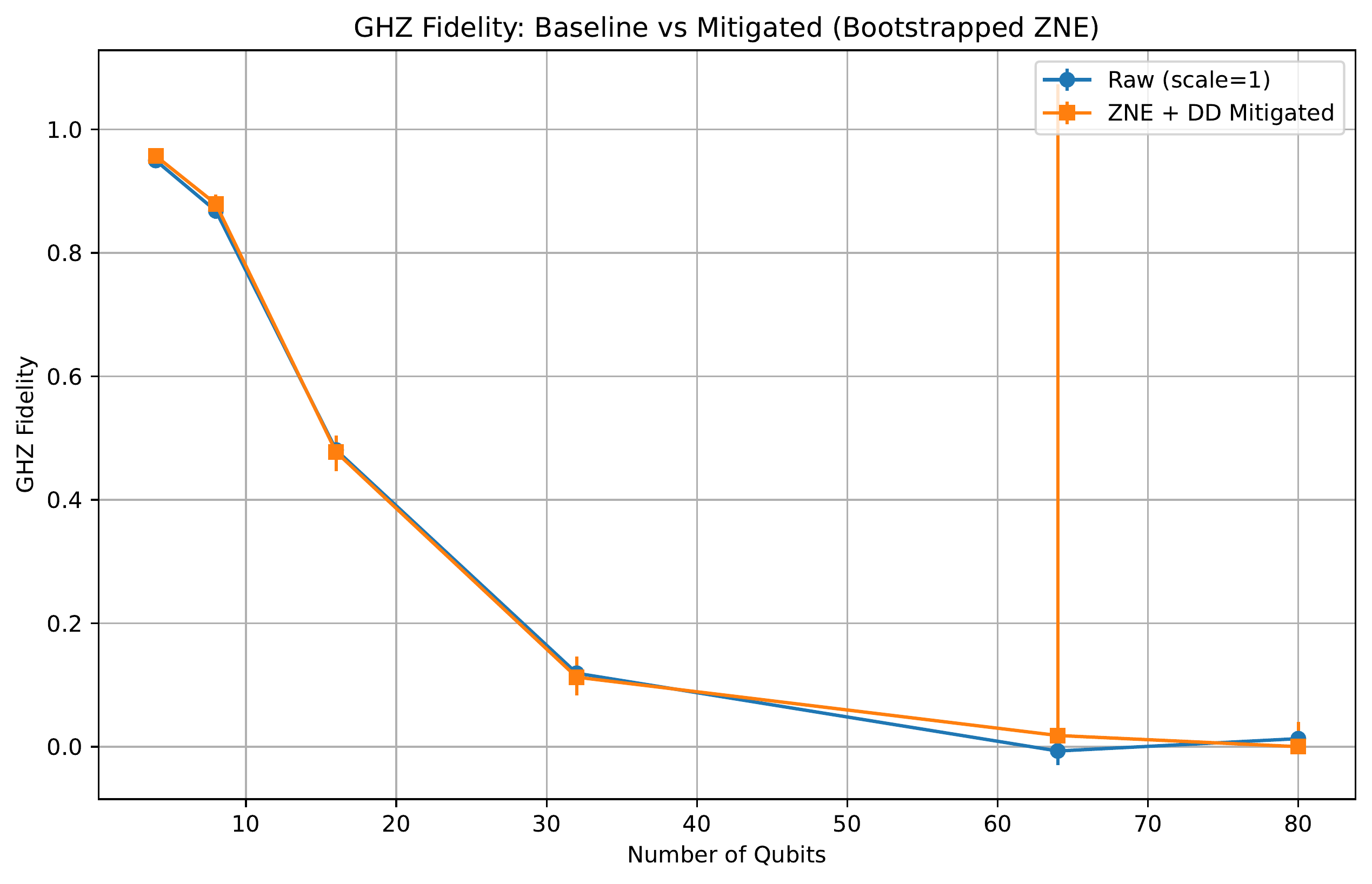 Raw vs mitigatedFidelity
 All 15 figuresFull atlas
Multi-partite GHZ entanglement on cloud superconducting processors collapses rapidly as qubit count grows. On a 156-qubit backend, 80-qubit raw fidelity was 0.013 (95% CI: −0.008 to 0.033). We present a modular, open-source pipeline combining zero-noise extrapolation (ZNE) with gate-level XY4 dynamical decoupling (DD). For N ∈ {4,8,16,32,64,80}, XY4 preserved parity longer at small N but yielded at most ~1% absolute gain. Exponential ZNE did not recover usable entanglement beyond 16 qubits. All code, raw counts, and figures are archived at DOI 10.5281/zenodo.20617751.
Introduction
The N-qubit GHZ state is a canonical probe of coherence and multipartite entanglement on NISQ hardware. Under realistic noise, global dephasing converts the state into a classical mixture; parity observables ⟨X⊗N⟩ vanish as N grows.
Can software-only error mitigation—ZNE combined with gate-level XY4 dynamical decoupling—restore practically useful entanglement without pulse-level hardware access?
Theoretical Framework
GHZ Fidelity Metric
Dynamical Decoupling (XY4)
XY4 inserts periodic X–Y–X–Y inversion pulses that refocus qubit phases and filter low-frequency dephasing at the gate level—portable across cloud backends without pulse calibration.
Zero-Noise Extrapolation
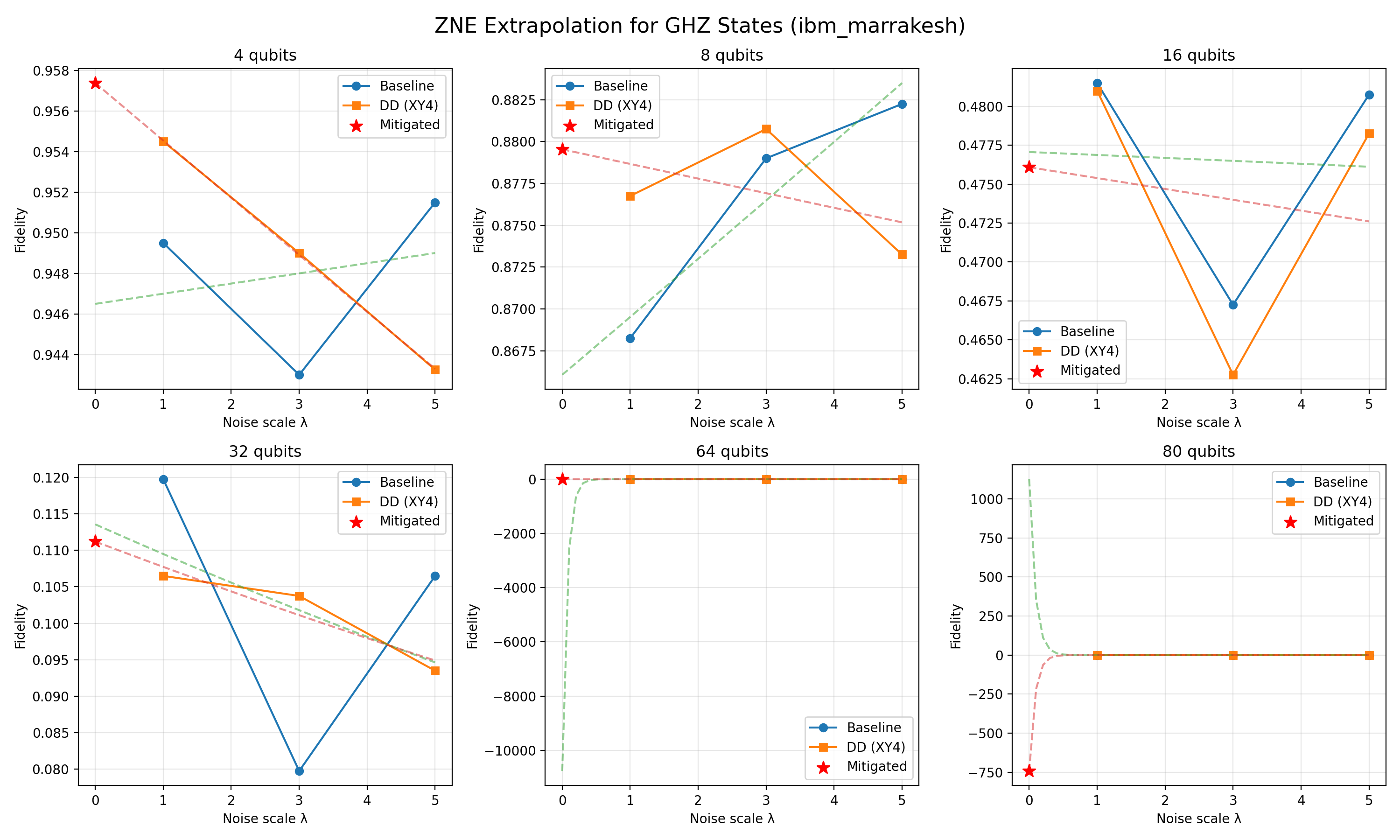
ZNE amplifies effective noise via digital gate folding (odd λ ∈ {1,3,5}), measures fidelity at each scale, and extrapolates to λ = 0 using F(λ) = F0 exp[−c(λ−1)].
Pipeline and Experimental Design
Executed on IBM Quantum ibm_marrakesh (156 qubits) for N ∈ {4,8,16,32,64,80}. Each size runs 12 circuits (baseline/DD × 3 noise scales × Z/X basis), 2000 shots each, with 500 multinomial bootstraps and GPU-accelerated exponential ZNE fitting.

Results and Analysis
Raw Fidelity Collapse
| N | Raw F | Interpretation |
|---|---|---|
| 4 | 0.950 | Excellent |
| 8 | 0.868 | Good |
| 16 | 0.481 | Below 0.5 threshold |
| 32 | 0.119 | Broken |
| 64 | −0.007 | Statistically zero |
| 80 | 0.013 | Statistically zero |
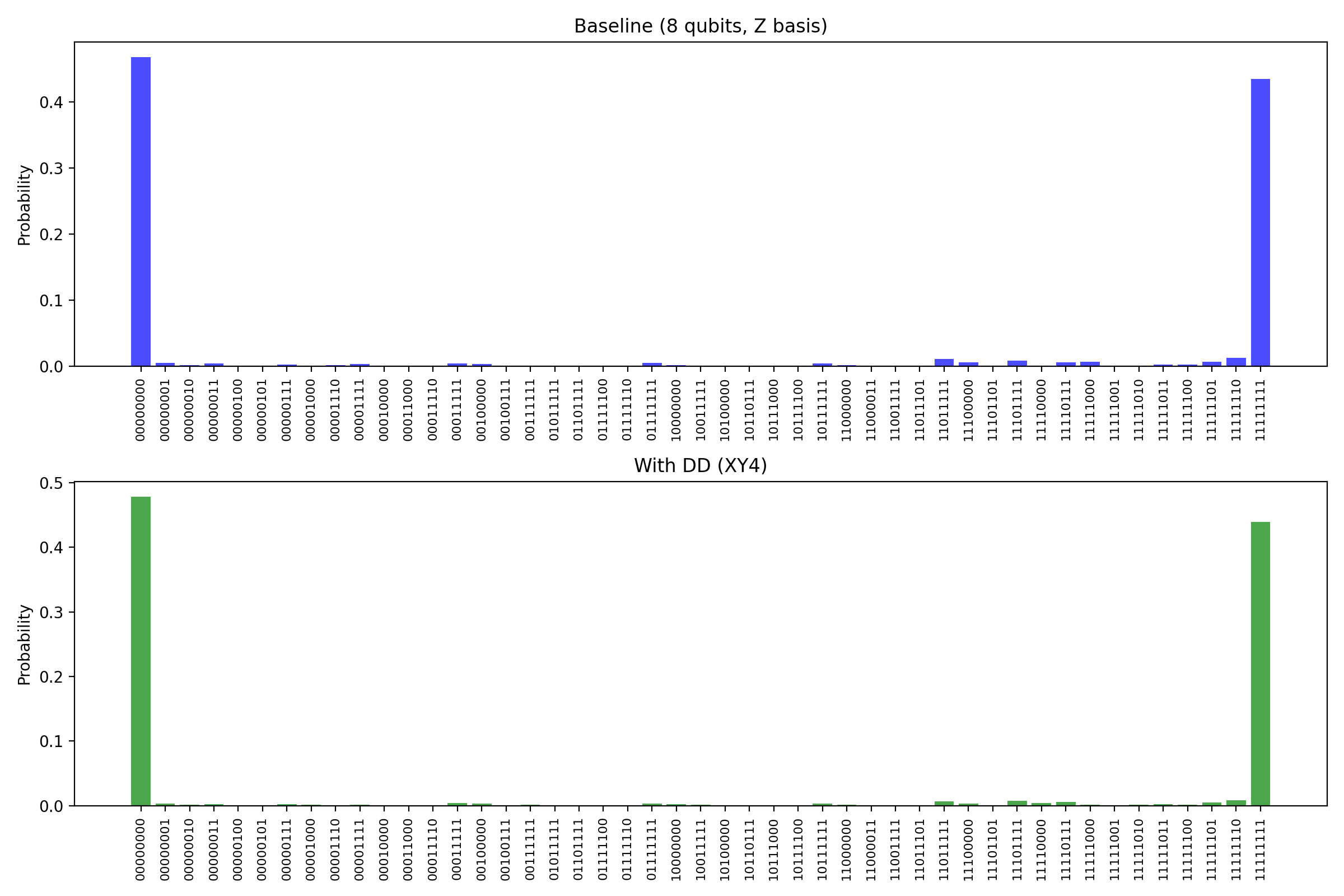
Dynamical Decoupling at N=8
Zero-Noise Extrapolation
| N | Raw F | Mitigated F | Factor |
|---|---|---|---|
| 4 | 0.950 | 0.957 | 1.01× |
| 8 | 0.868 | 0.879 | 1.01× |
| 16 | 0.481 | 0.477 | 0.99× |
| 32 | 0.119 | 0.113 | 0.95× |
| 64 | −0.007 | 0.018 | — |
| 80 | 0.013 | 0.000 | 0.00× |
QBER and Quantum Networking
| N | Mitigated F | QBER | Secure? |
|---|---|---|---|
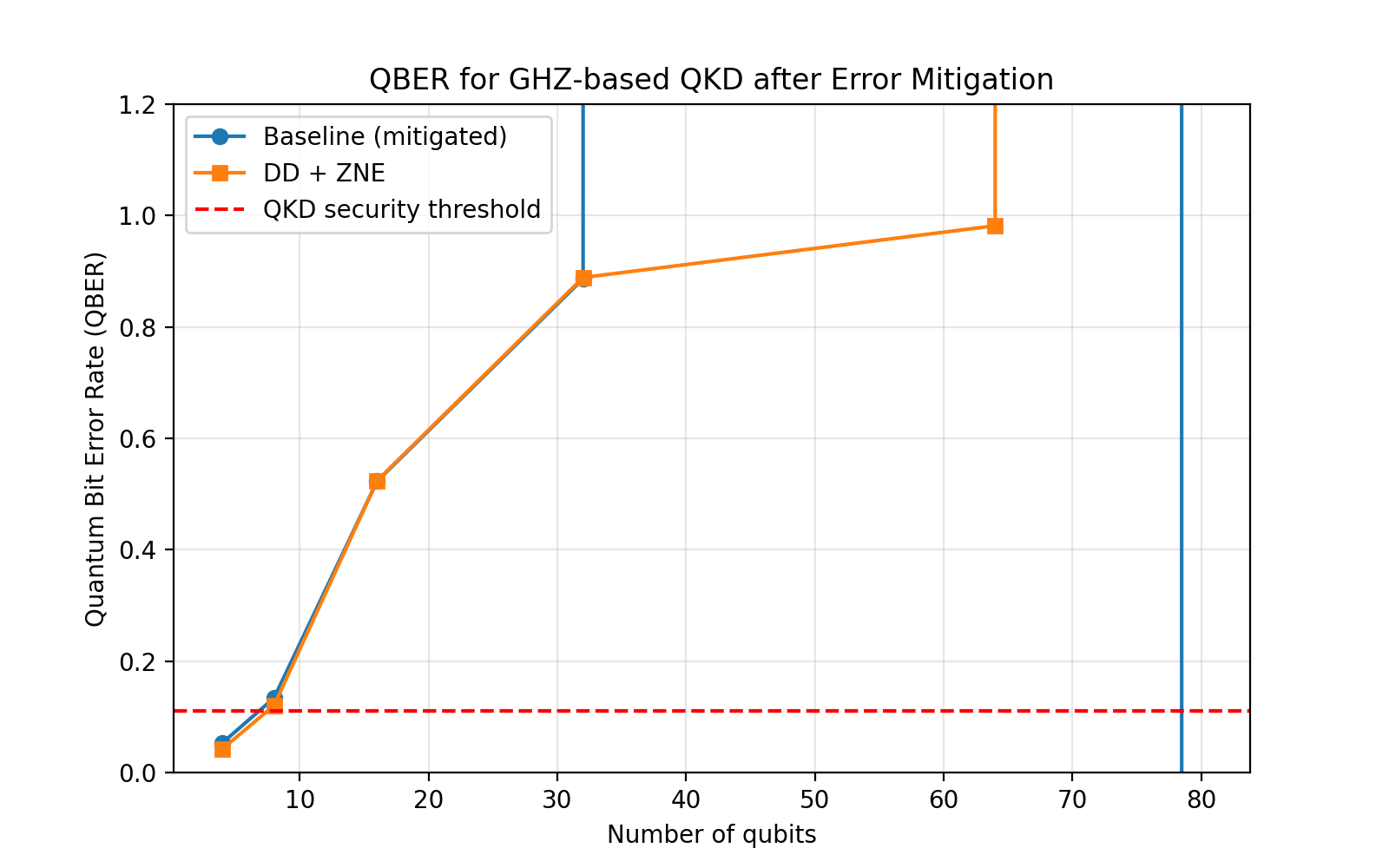
| 4 | 0.957 | ≈4.3% | Yes |
| 8 | 0.879 | ≈12.1% | Borderline |
| 16 | 0.477 | ≈52.3% | No |
| 32 | 0.113 | ≈88.7% | No |
| 64 | 0.018 | ≈98.2% | No |
| 80 | 0.000 | ≈100% | No |
Complete Figure Atlas
Every circuit diagram, calibration snapshot, extrapolation panel, and networking plot from the paper — browse by category or thumbnail. Fifteen assets at publication resolution — click any figure to zoom full size.
Conclusion
Gate-level DD+ZNE provides modest gains at small N (0.950 → 0.957 at 4 qubits) but cannot resurrect coherence at large N. Coherence resurrection at 64–80 qubits awaits lower two-qubit gate error or pulse-calibrated dynamical decoupling. The pipeline is a reproducible baseline archived at Zenodo.
Full paper, code & raw counts
DOI 10.5281/zenodo.20617751 · Open access · CC BY 4.0