Multiple path bonding for quantum networks

Quantum Multipath Bonding · MPTCP + QKD/PQC + Traffic Intelligence

Download paper

Kryptur Research presents a layered platform that bonds Multipath TCP transport, hybrid Quantum Key Distribution with post-quantum cryptography, and laboratory Bell-state path intelligence — keeping sessions alive across satellite, cellular, and fiber.

Link
active
Bonding status · CDNER-X lab console
Throughput
250 Mbps
Engine snapshot across three paths
Latency
15 ms
Compose-mode laboratory measurement
Health
quantum ready
Platform probe · CDNER-X

Recent news

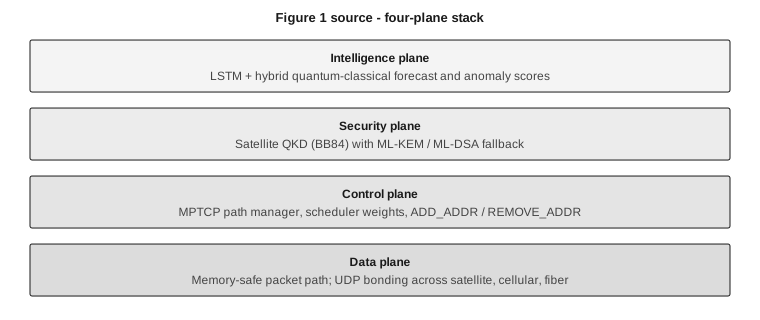
Four-plane stack with independent graceful fallbacks

Figure 1
Data · Control · Security · Intelligence
Architecture

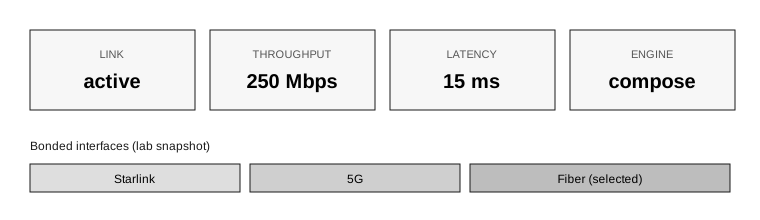
Laboratory telemetry — active link, 250 Mbps, 15 ms

Dashboard
Bonding status service · compose engine
CDNER-X
Open access archive on ZenodoRead more research on our hub

Stay up to date

with the latest from

Kryptur Research on

LinkedIn

Tools + Code

Results & figures

Table 1. Architectural planes and failure behaviour
PlaneResponsibilityGraceful fallback
DataForwarding on the hot pathRemaining interface continues as ordinary IP
ControlMPTCP lifecycle and schedulingWeighted round-robin or lowest-RTT
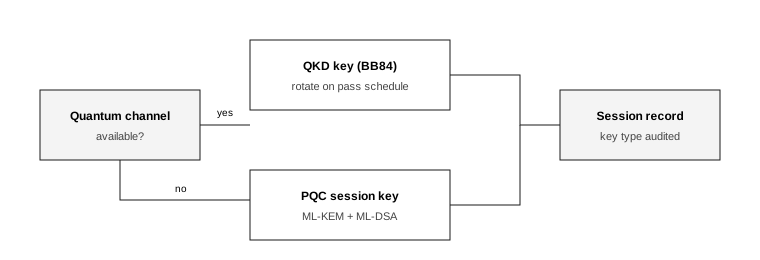
SecurityQKD where available; PQC elsewhereML-KEM / ML-DSA only
IntelligenceForecast and anomaly scoresFreeze last known-good weights
Four-plane Quantum Multipath Bonding architecture
Figure 1. Four-plane stack — intelligence, security, control, and data.
Table 2. Laboratory bonded-path inventory
NameKindBindTarget
Starlinksatellite127.0.0.1:9001127.0.0.1:10001
5Gcellular127.0.0.1:9002127.0.0.1:10002
Fiberterrestrial127.0.0.1:9003127.0.0.1:10003
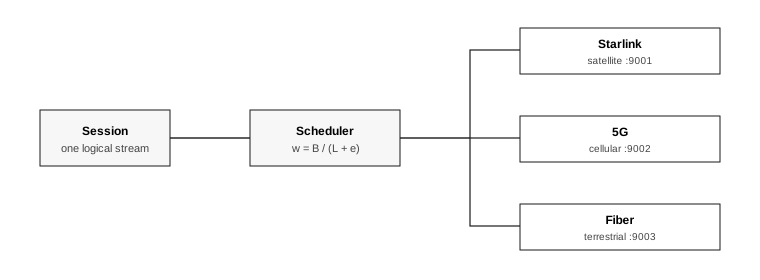
Session to scheduler to three bonded paths
Figure 2. Bonded paths — session → scheduler → Starlink / 5G / Fiber.
Laboratory telemetry tiles
Figure 3. Laboratory telemetry from the bonding status service.
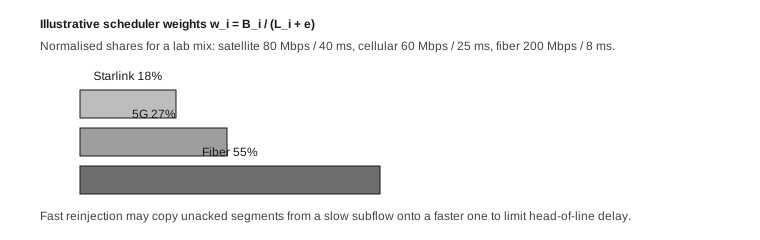
Scheduler weight formula visualization
Figure 4. Scheduler starting point: weighti = bandwidthi / (latencyi + ε).
Table 3. Satellite-QKD design parameters & PQC primitives
ItemTarget / role
Wavelength1550 nm
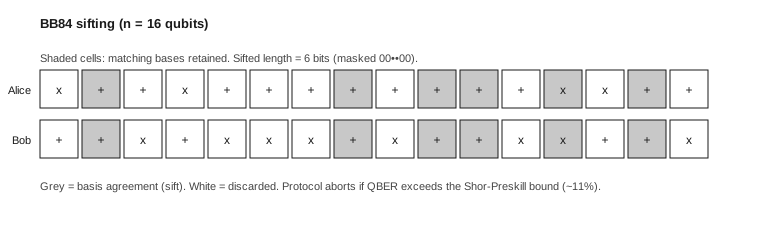
ProtocolDecoy-state BB84 · abort ~QBER > 11%
FIPS 203 ML-KEMKey encapsulation when QKD is absent
FIPS 204 ML-DSASignatures and authentication (ML-DSA-65 default)
BB84 Alice and Bob basis agreement
Figure 5. BB84 sifting — Alice/Bob basis agreement.
Hybrid QKD and PQC key management
Figure 6. Hybrid key management — QKD pass or ML-KEM + ML-DSA.
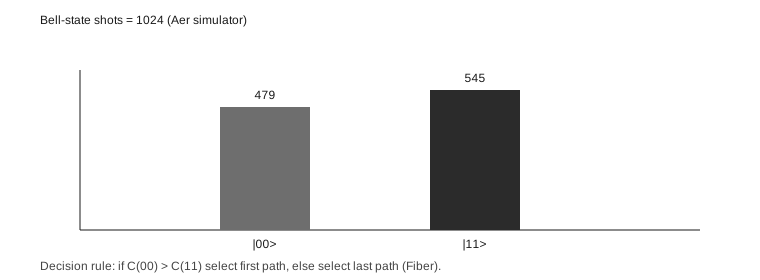
Table 4. Bell-state path-optimization snapshot
ItemValue
Algorithmbell_state_path_optimization
Shots1024
Count of 00 / 11479 / 545
Selected pathFiber
Bell-state histogram 00 versus 11
Figure 7. Bell-state counts — laboratory mechanism selecting Fiber (not a quantum-advantage claim).
Table 5. Application mapping
SettingBonded mixSecurity note
MaritimeLEO, GEO, coastal cellularContinuity across beam and coastal hand-over
Remote miningSatellite, 4G, site meshHybrid QKD/PQC for operations data
Disaster responseWhatever links remainProtect medical and command traffic
Enterprise backupFiber, 5G, satelliteShift load before the primary path fails

Authors & related research

Raja Ram M. — Main author, R&D lead, corresponding author (Kryptur OU / Krypur Quantum R&D). Contributors: Muskan S. (Data T), Vipul Jain (AE Quantum / DCN), Kalinga Swain (Zius). Data manager: Borel Sigma Data Center.