The future of quantum biology is now

Vibrational Quantum Olfaction

Download paper

Kryptur Research presents DFT vibrational analysis, WKB tunneling through the HCN elimination barrier, and IETS fingerprints linking benzaldehyde and hydrogen cyanide in almond cyanide biology.

HCN barrier
20
kcal/mol · quartic elimination profile
Tunnel half-life
26 ps
vs. 257 ps classical at 300 K
IETS peak ΔV
1.2 meV
Benzaldehyde vs. HCN · 10 cm⁻¹ separation
Tunnel enhancement
~10×
k = 2.69×10⁻² s⁻¹ corrected rate

Research highlights

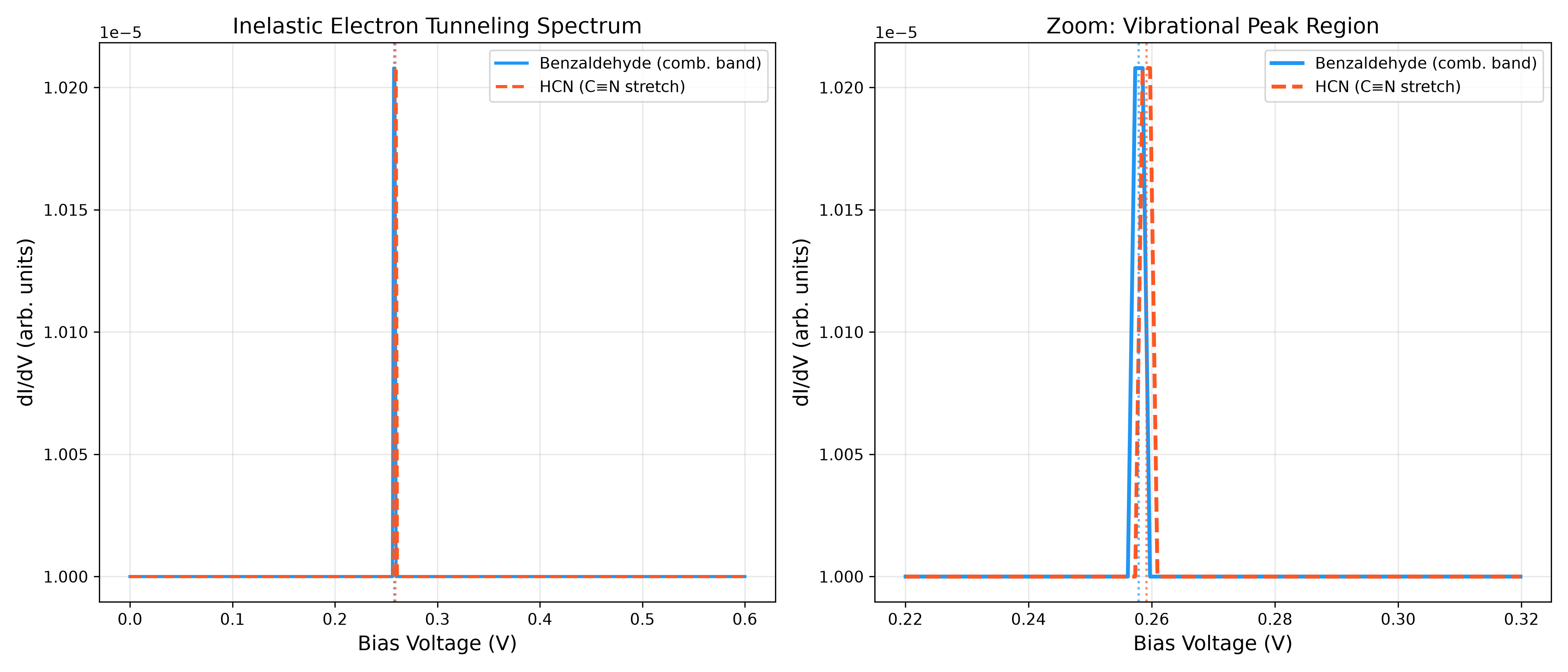
Simulated IETS dI/dV spectra — benzaldehyde, HCN, control

Figure 1
Combination band vs. C≡N stretch
SpectroscopyOlfaction

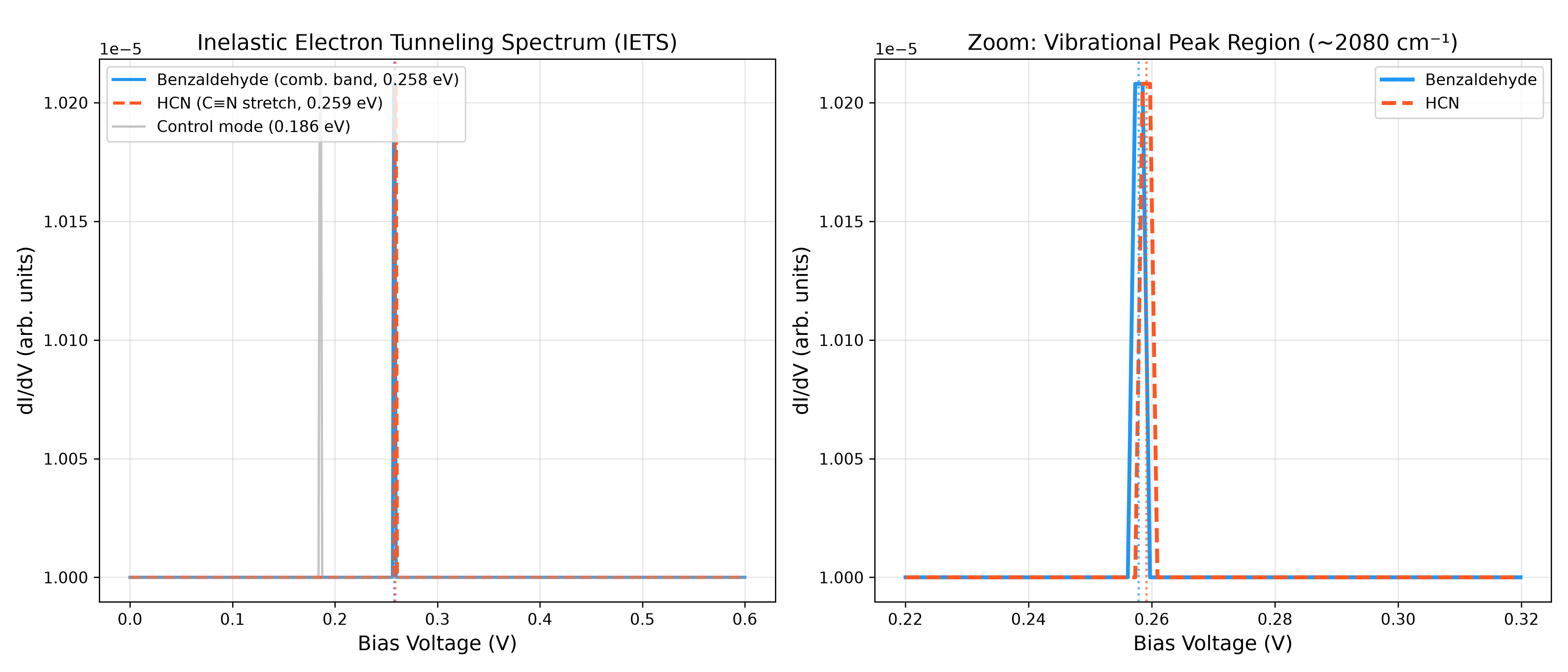
Peak region zoom — indistinguishable olfactory activation

Figure 2
ΔV = 0.002 V ≡ 1.2 meV
BenzaldehydeHCN
Explore interactive quantum dashboard on GitHubRead more research on our hub

Results & figures

Table 1. IETS peak voltages and frequency separation
MoleculeVibrationIETS Peak (V)
BenzaldehydeCombination band (2080 cm⁻¹)0.257
HCNC≡N stretch (2090 cm⁻¹)0.259
Peak separationΔV = 0.002 V1.2 meV (10 cm⁻¹)
Table 2. HCN elimination kinetics at 300 K
ModelRate (s⁻¹)Half-life
Classical (TST)2.69×10⁻³257 ps
WKB tunnel-corrected2.69×10⁻²26 ps
Simulated inelastic electron tunnelling spectrum for benzaldehyde, HCN, and control mode
Figure 1. Simulated IETS spectrum (dI/dV) for benzaldehyde (combination band, 2080 cm⁻¹), HCN (C≡N stretch, 2090 cm⁻¹), and a control mode (1500 cm⁻¹). Vertical dashed lines mark vibrational onsets.
Detailed IETS comparison for benzaldehyde and HCN in the vibrational peak region
Figure 2. Detailed IETS comparison in the ~2080 cm⁻¹ region. The 1.2 meV separation lies within typical experimental linewidths, supporting indistinguishable olfactory activation.

Full paper, dashboard & data

Research Paper: https://doi.org/10.5281/zenodo.20691555 · Open access · Zius Quantum R&D Center · Kryptur OU

Research Paper

Stay up to date

with the latest from

Kryptur Research on

LinkedIn

Tools + Code